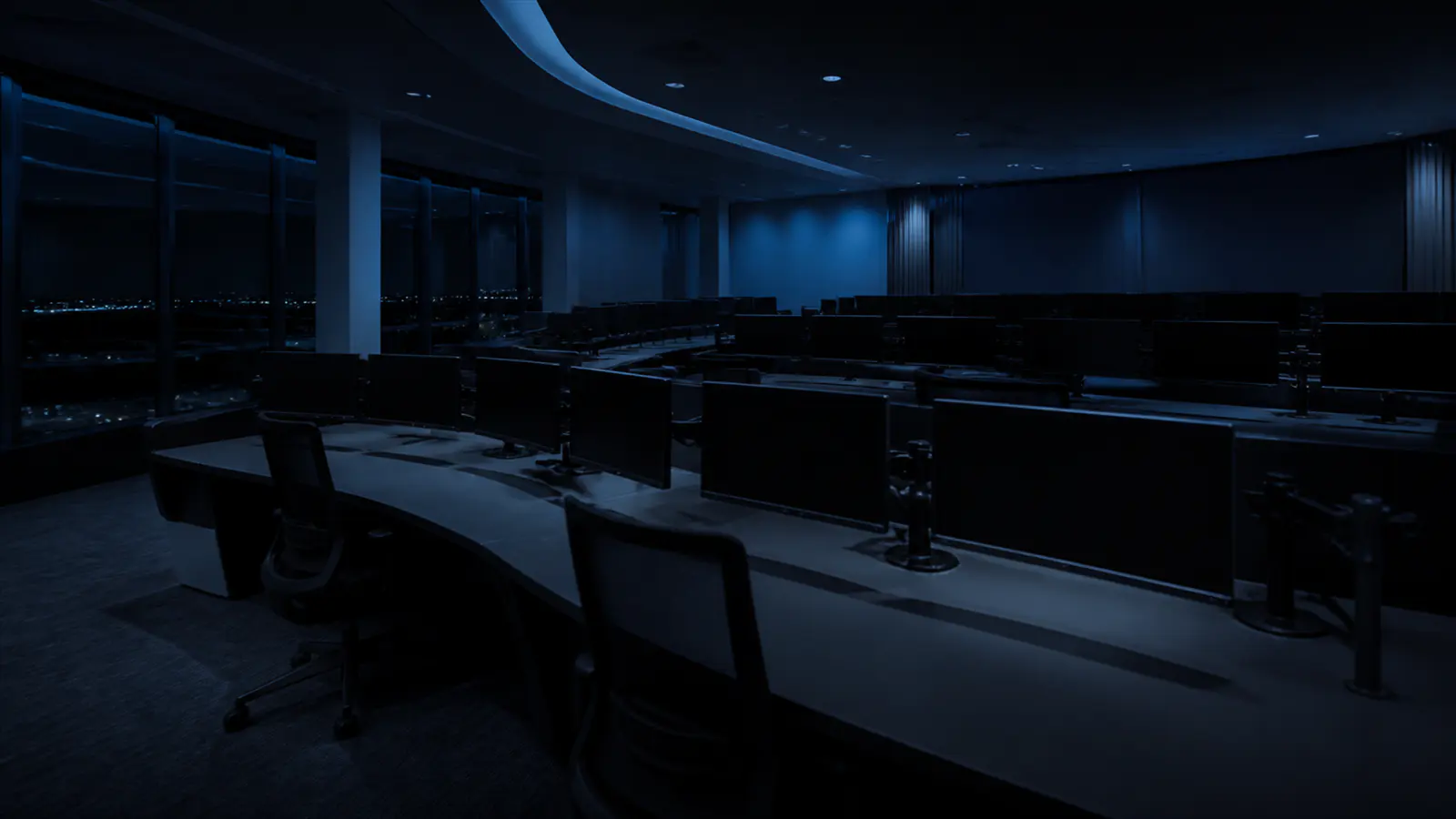
An operations centre you run, not an operations desk you rent.
Fleet management for uncrewed aircraft usually arrives as a service: your video, your telemetry and your incident record travel out to somebody else, and command sits with a supplier. This is the other model. We assess the site, design the room, build it on your infrastructure, integrate it with the systems you already dispatch on, train your crew against your own data, and then leave.
When an inquiry asks who held command, the answer should be your watch officer.
The distinction is not technical, it is one of authority. An outsourced operation puts a third party between your organisation and its own airspace decisions — and the record of those decisions ends up in their system, on their retention policy, under their jurisdiction. A commissioned centre keeps command, the log and the console inside your organisation, which is the only arrangement that survives being asked about afterwards.
Six phases, ending in us leaving.
A commissioning engagement, not a subscription. Each phase produces something you keep, and the last one is an exit — the room works afterwards without a retainer, which is the test of whether it was built properly.
- 01
Assess
Site walkthrough: connectivity, power, radio coverage, sightlines, and what already exists that the room has to live with.
DeliverableSite assessment - 02
Design
Floor plan, wall source map, network topology, role definitions and a shift model sized to your flight tempo rather than to a template.
DeliverableDesign pack - 03
Build
Physical fitout and platform deployment onto your infrastructure — on premises, private cloud, or air-gapped.
DeliverableCommissioned room - 04
Integrate
Wiring to the external systems that matter: radio, video, dispatch, notification. Configuration committed to your repository.
DeliverableIntegration record - 05
Train
Competency-based training on your consoles against your data, with tabletop drills and a recorded standard per role.
DeliverableCompetency records - 06
Handover
Acceptance testing, then we go. No residual dependency, no standing retainer required to keep the room working.
DeliverableAcceptance and exit
Five categories, wired on site.
These are delivered by the engagement and integrated in your building. They are not shipped platform adapters, and we do not let the two blur — an integration built once for one client is not a product feature.
Voice and push-to-talk
TETRA, DMR and broadband MCPTT patched into the dispatcher console, so the room talks on the network your responders already carry.
Video management
Fixed cameras and drone feeds on the same wall, with camera call-up driven from the incident rather than hunted for by hand.
CAD and EMS dispatch
Incident to launch proposal, with a correlation ID that keeps the flight and the call joined in the record from first ring to after-action.
Crisis management and mass notification
Verified incidents pushed out to responders, acknowledgements pulled back onto the board.
Physical build
Wall, consoles, KVM, connectivity and power, delivered by contractors against our design and accepted against our tests.
Sized to the furthest position, not to the photograph.
Video wall
Legible from the seat furthest from it, which is a different specification from the one that photographs well.
Operator positions
Sightlines and KVM, arranged so an operator can see the wall and their own console without choosing.
Watch officer station
Raised and behind the line, able to see every position and the wall at once.
Comms and equipment room
Racks, radio gateways and the platform, on your infrastructure and inside your perimeter.
Power and continuity
UPS with a load-tested changeover and dual-path connectivity — tested under load, not assumed.
Briefing and welfare
Somewhere to hand over, brief and rest. Rooms without one degrade on the third consecutive shift.
Four roles, all of them yours.
Every position is filled by your employees, and competency is recorded in your system rather than ours. Shift models scale from an on-call arrangement to 24/7 with three watches rotating through four teams.
Watch officer
Holds the watch and authorises within a written delegation.
RPAS operator
Flies the mission and owns the abort call. One to three per watch depending on tempo.
Authority liaison
The named connection to the civil aviation authority, rostered or on call.
Systems and comms technician
Keeps the wall, the radios, the links and the platform alive.
Six drills, run under load, before anyone signs.
Acceptance is not a document review. These are executed in the room, with the crew who will hold the watch.
Start with the problem, not the catalogue.
A scoping session establishes what you are actually trying to achieve, what is already in place, and whether we are the right people for it. If we are not, we will say so.